
Kia has a very specific gift. They know how to read the room.
When the Sonet launched, it understood that the sub-4-metre SUV buyer wanted features and presence over everything else. When the Seltos arrived, it rewrote what a mid-size SUV could look and feel like at that price. Both cars worked because Kia paid attention to what Indian buyers were actually asking for not just what they said they wanted, but what they were responding to.
The Syros is Kia asking a different question. What if the next compact SUV did not try to look sporty? What if it went the other direction entirely – tall, boxy, upright, and completely unbothered about being called a crossover?
Launched in India in January 2025 and positioned between the Sonet and Seltos, the Syros is a sub-4-metre SUV with a genuinely unusual design personality. It is not trying to be a Creta rival. It is not trying to be a performance machine. It is trying to be the most practical, most liveable, most feature-rich compact SUV in the country and it backs that up with a 5-star Bharat NCAP rating earned in February 2025.
We drove the diesel automatic. Here is everything you need to know.
Pricing & Variants
The Syros is available across seven broad trims HTE, HTE(O), HTK EX, HTK Plus, HTK Plus(O), HTX, and HTX(O) with both petrol and diesel engine options and a choice of manual or automatic gearboxes depending on the variant.
The petrol is a 1.0-litre turbo unit paired with either a 6-speed manual or a 7-speed DCT. The diesel is a 1.5-litre CRDi unit paired with a 6-speed manual or a 6-speed torque converter automatic. The diesel automatic is only available on the HTX and HTX(O) variants the upper end of the range.
As of May 2026, pricing is as follows:
| Variant | Engine | Transmission | Ex-Showroom Price |
| HTE | 1.0 Petrol | 6MT | Rs. 8.40 lakh |
| HTE(O) | 1.0 Petrol | 6MT | Rs. 9.20 lakh |
| HTK EX | 1.0 Petrol | 6MT | Rs. 9.89 lakh |
| HTK Plus | 1.0 Petrol / 1.5 Diesel | 6MT / 7DCT | Rs. 11.00 lakh onwards |
| HTK Plus(O) | 1.0 Petrol / 1.5 Diesel | 6MT / 7DCT | Rs. 12.00 lakh onwards |
| HTX | 1.0 Petrol / 1.5 Diesel | 7DCT / 6AT | Rs. 13.50 lakh onwards |
| HTX(O) | 1.0 Petrol / 1.5 Diesel | 7DCT / 6AT | Rs. 15.80 lakh (top spec diesel AT) |
The diesel automatic in HTX(O) trim the variant we drove sits at Rs. 15.80 lakh ex-showroom. For a sub-4-metre SUV, that is a significant ask. Whether it justifies that number is the real question this review answers.
Dimensions
| Parameter | Measurement |
| Length | 3,995 mm |
| Width | 1,805 mm |
| Height | 1,680 mm |
| Wheelbase | 2,550 mm |
| Boot Space | 390 to 465 litres (sliding rear seat dependent) |
| Ground Clearance | 190 mm |
The wheelbase is 50mm longer than the Sonet and you feel every one of those millimetres in the rear seat.
Exterior Design
The Syros does not ask for your approval. It just shows up.
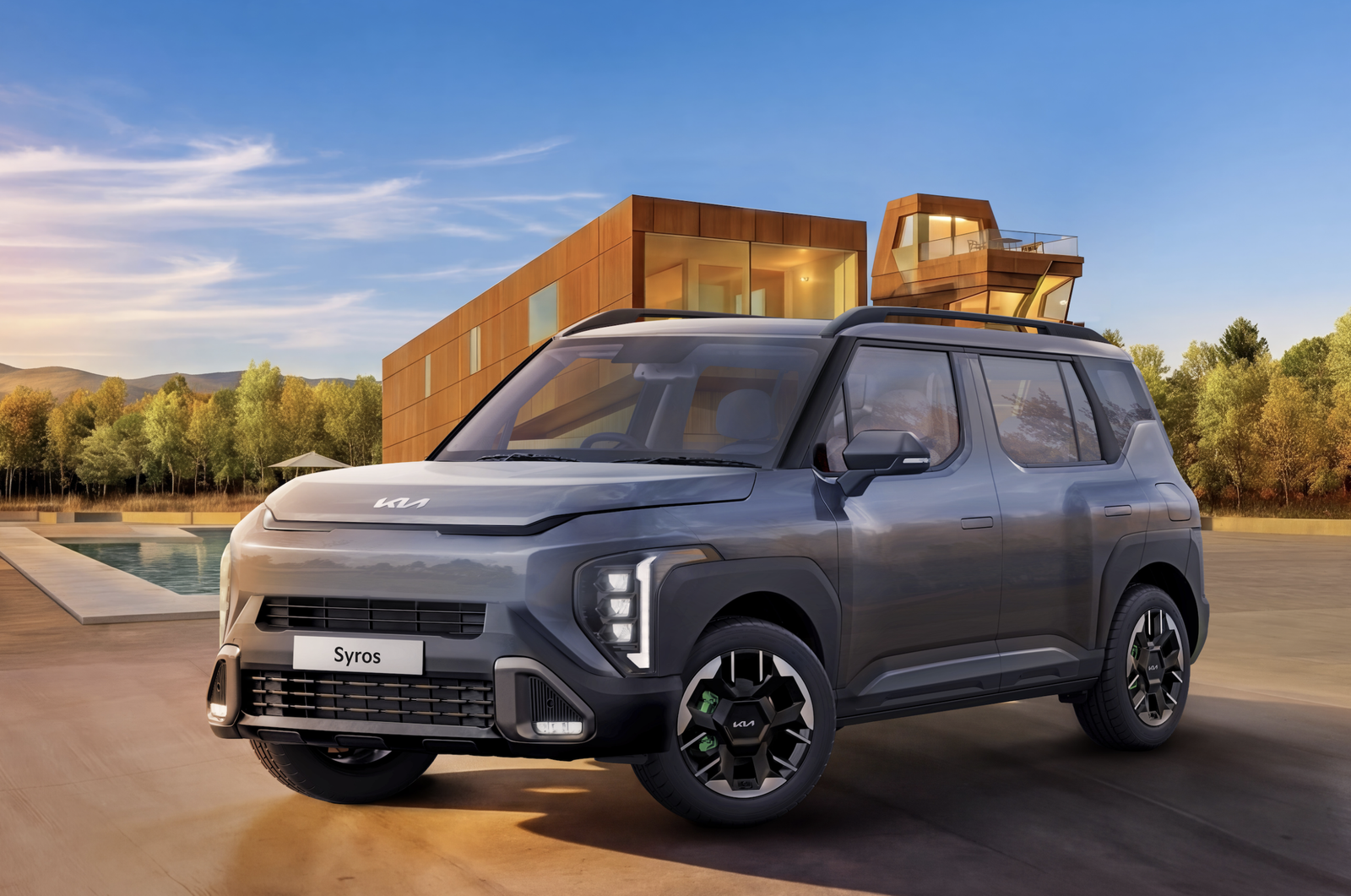
In a segment full of cars trying to look sporty with swept headlamps, coupe-ish rooflines, and aggressive fake vents, the Syros does the exact opposite. It is tall, upright, and architecturally boxy. Short overhangs, a wide glasshouse, squared wheel arches, and flat body panels — this is a car designed around the idea that interior space and visibility matter more than visual drama.
The front end is where the character is most concentrated. Vertical LED light bars flank the face, and the angular headlamps with their distinctive DRL signature give the Syros a face that looks nothing like anything else in the segment. The 2026 update adds body-coloured aero inserts on the bumper, an updated grille, and gloss black skid plates, which tighten the exterior presentation without changing the fundamental character.
The side profile is clean. Flush door handles, a strong shoulder line, and black roof rails keep the surfaces uncluttered. The 17-inch diamond-cut alloys with neon brake callipers are a genuinely distinctive detail — the callipers flash colour when you brake, which is the kind of thing that sounds gimmicky on paper and looks surprisingly good in person.
At the rear, the updated bumper, high-mounted LED stop lamp, and gloss black skid plate finish the design with the same upright confidence the front established.
Eight colour options are on offer Glacier White Pearl, Sparkling Silver, Pewter Olive, Frost Blue, Intense Red, Aurora Black Pearl, Imperial Blue, and Gravity Gray. The lighter shades work best with the flat surfaces, making the boxy geometry feel purposeful rather than plain.
This is not a conventionally pretty car. But it has a very clear point of view, and in a segment where everything looks similar, that actually counts for something.
Design Signature
The most distinctive design decision on the Syros is the vertical LED light bar treatment at the front corners — two separate, upright pillars of light that frame the face like architectural columns rather than swept, horizontal lamp clusters. Every other car in this segment uses horizontal lighting to look wider and more aggressive. The Syros uses vertical light elements to look taller and more purposeful. It is a deliberate inversion of the standard compact SUV design grammar, and it is what makes the Syros instantly recognisable from 100 metres away in a parking lot full of its competitors.
Interior & Cabin
The Syros cabin is where the argument for the car is made most convincingly.
The centrepiece is the 30-inch Trinity Panoramic Display — a single seamless panel housing a 12.3-inch touchscreen, a 12-inch digital instrument cluster, and a 5-inch dedicated climate control display. It sounds excessive when described like that, but in person the layout is genuinely well resolved. The screens are sharp, the UI is clean, and having a dedicated display for climate controls means you are not navigating menus just to change the temperature. The main climate toggles below are physical, which is the right call.
CMF quality is good for the price point. Soft touch surfaces appear at all key contact areas — the dashboard top, door inserts, and armrests. The cabin theme in the HTX(O) feels considered rather than generic. Fit and finish is solid, with panel gaps that stay consistent and no obvious cost-cutting at visible trim points.
The driver seat is electrically adjustable and the driving position is excellent — elevated but not bus-like, with good forward visibility aided by large windows and well-proportioned pillars. The D-cut steering wheel with media and ADAS controls falls naturally to hand.
Storage is practical throughout. Bottle holders, a wireless charging tray, a usable glovebox, and a deep centre console cover the daily needs without fuss. The Harman Kardon 8-speaker sound system is genuinely good — clear separation, controlled bass, and wide soundstage for a car at this price.
The dual-pane panoramic sunroof opens up the roofline and makes the already tall cabin feel even more airy. Ambient lighting adds a mood layer to night drives without being garish.
One caveat worth naming honestly: the MY2026 update removed the 360-degree camera and Level 2 ADAS from some variants. If these features matter to you, verify trim-level availability before purchasing rather than assuming they come as standard.
Rear Seat
This is the section where the Syros makes its strongest case.
The sliding and reclining rear seat is not just a feature — it is the feature that makes the Syros genuinely different from every other car in this segment. You can slide the rear bench forward for maximum boot space, or push it back for maximum passenger legroom. You can recline it for a more relaxed posture on a long highway run. And the rear seat ventilation cushion — a segment-first feature — means rear passengers are not sitting in a heat trap during Indian summers.
Headroom is generous because of the tall roofline. Legroom in the full-back position is excellent. Under-thigh support is adequate for adults on most journey lengths. Ingress and egress are easy — the upright stance and wide door apertures mean elderly passengers and children get in and out without contorting themselves.
The 60:40 split function means the boot space can be expanded when needed, and with rear seats fully forward, you get 465 litres. With them slid back to prioritise comfort, you still have 390 litres. That is a genuinely clever solution for a sub-4-metre footprint.l gaps that stay consistent and no obvious cost-cutting at visible trim points.
The driver seat is electrically adjustable and the driving position is excellent — elevated but not bus-like, with good forward visibility aided by large windows and well-proportioned pillars. The D-cut steering wheel with media and ADAS controls falls naturally to hand.
Storage is practical throughout. Bottle holders, a wireless charging tray, a usable glovebox, and a deep centre console cover the daily needs without fuss. The Harman Kardon 8-speaker sound system is genuinely good — clear separation, controlled bass, and wide soundstage for a car at this price.
The dual-pane panoramic sunroof opens up the roofline and makes the already tall cabin feel even more airy. Ambient lighting adds a mood layer to night drives without being garish.
One caveat worth naming honestly: the MY2026 update removed the 360-degree camera and Level 2 ADAS from some variants. If these features matter to you, verify trim-level availability before purchasing rather than assuming they come as standard.
Features That Actually Matter
The Syros HTX(O) is heavy on features, but a few earn their place through real-world value rather than just brochure presence.
The sliding rear seat with ventilation is the standout ownership feature. Anyone who has sat in the rear of a compact SUV on a summer afternoon in Delhi traffic will immediately understand why this matters. The combination of reclining function and seat-level ventilation turns the rear of the Syros into a genuinely comfortable place on long drives — not just tolerable.
The OTA software update system for 16 controllers is a feature most buyers will not think about at the showroom but will appreciate over three years of ownership. Software bugs fixed without a dealership visit, new features pushed silently — this is the kind of future-proofing that adds real ownership value.
The Kia Connect 2.0 suite with 80-plus connected features works reliably and without the typical lag or disconnection issues that plague many connected car systems in India. Remote engine start, live location, geo-fencing — these function as advertised.
The 17-inch alloys with neon brake callipers are a visual feature, but one that is genuinely expressive and distinctive. In a segment where every car starts to look the same at a traffic light, small personality touches like this matter for the kind of buyer the Syros is targeting.
Safety
The Kia Syros earned a 5-star Bharat NCAP safety rating in February 2025. In a segment where safety ratings are increasingly a primary buying consideration, this is a genuinely significant credential and one of the Syros’s clearest advantages over several rivals.
Standard safety equipment includes 6 airbags, ABS with EBD, electronic stability control, hill start assist, and ISOFIX child seat anchors. Higher variants add Level 2 ADAS with adaptive cruise control, front collision warning with autonomous emergency braking, lane keep assist, lane follow assist, and auto high-beam.
As noted in the cabin section, the 360-degree camera and ADAS suite have been removed from some variants in the MY2026 update. Confirm your variant’s safety specification before finalising the purchase.
Engine & Transmission
The 1.5-litre CRDi diesel produces 116 PS and 250 Nm of torque. It is the same family of engine that does duty across the Sonet, Seltos, and Carens — well-proven, refined for Indian conditions, and with a character that suits everyday driving more than outright performance.
In real-world conditions, the engine is exactly what a family-focused compact SUV needs. Mid-range response is strong — the 250 Nm torque figure is felt in the 2000 to 3500 rpm range where city overtaking and highway cruising both live. The engine does not feel strained with a full load of passengers, which matters more than peak power figures for the typical Syros buyer.
The 6-speed torque converter automatic is smooth and unobtrusive. It is not the fastest gearbox in this segment — the DCT on the petrol is sharper in response — but it is more comfortable to live with in stop-go city traffic, where a DCT can get jerky at low speeds. The torque converter absorbs the city rhythm without drama, which is the right tradeoff for a family-comfort-first vehicle.
Paddle shifters are present and functional. They are not transformative in a torque converter automatic the way they might be in a DCT, but they give you a useful tool when driving on gradients or wanting immediate response in a specific situation.
ARAI certified mileage is 17.65 kmpl for the automatic. Real-world figures come in around 12 to 13 kmpl in city conditions and 18 to 20 kmpl on highways from owner-reported data. For a diesel automatic, these are respectable numbers.
Driving Dynamics & Braking
The Syros drives like it was designed — with comfort and stability as the priorities, not engagement.
Braking performance is confident. All-wheel disc brakes give the Syros proper stopping authority for its weight class, and the pedal feel is progressive and predictable. The ABS and ESC systems intervene cleanly without being intrusive.
ADAS functions — where equipped — work reliably on highways. The adaptive cruise control holds gaps without being nervous, and the lane keep assist is gentle rather than aggressive in its corrections. For anyone doing regular highway driving between cities, these systems add a genuine layer of confidence over time.
The body-on-frame caveat does not apply here — the Syros is a monocoque, so the ride and handling baseline is better composed than you might expect from the tall, boxy stance. There is some body roll in sharper corners, consistent with the tall roofline, but it is predictable and not unsettling.
Ride & Handling
The suspension on the Syros leans stiff — noticeably so. This is one of the areas where the car makes a clear tradeoff. The stiffer setup controls body roll and gives the car stability at highway speeds, but it means sharper bumps and broken road surfaces are felt inside the cabin more than they would be in, say, a Baleno or an Altroz.
On properly laid highways, the ride is composed and comfortable. On the typical mix of broken patches, speed breakers, and potholed colony roads that make up daily urban driving in India, the Syros requires some adjustment. It is not punishing — just noticeably firmer than the competition at this price point.
Steering is on the heavier side in city conditions, which is surprising given the lighter feel that most compact SUVs offer. This makes slow-speed manoeuvring slightly more effort than expected. At highway speeds, the weight settles into a more natural zone and the car tracks well.
Wind noise becomes audible past 80 kmph, a predictable consequence of the tall, upright body shape and large glass area. It is not excessive, but highway users will notice it.
Value for Money
The HTK Plus is the sweet spot for most buyers. It brings the panoramic sunroof, cruise control, 60:40 split rear seats, and a more premium cabin theme — the features that define the Syros ownership experience — while remaining available across all powertrain options at a considerably lower price than the top trims.
The HTX is the right pick for buyers who specifically want the ventilated seats, 17-inch alloys with neon callipers, Harman Kardon audio, and the larger infotainment display. It is a meaningful step up in daily quality of life.
The HTX(O) diesel automatic — the variant we drove — is the most complete expression of what the Syros can be. But at Rs. 15.80 lakh ex-showroom for a sub-4-metre SUV, it demands honest justification. If the diesel automatic drivetrain, the full feature set, and the sliding ventilated rear seat are all important to you, the price is justified. If you are price-sensitive, the HTK Plus petrol at roughly half the price gives you most of the character for significantly less money.
Pros & Cons
Pros
- 5-star Bharat NCAP rating — one of the best safety credentials in the segment
- Sliding and reclining rear seat with ventilation is a genuinely class-leading feature
- Well-resolved cabin with quality materials and logical HMI layout
- 30-inch Trinity Panoramic Display is sharp, well-integrated, and practical
- Refined diesel engine with a smooth torque converter automatic
- Flexible boot space (390 to 465 litres) is clever packaging for a sub-4-metre car
- OTA updates for 16 controllers — meaningful long-term ownership advantage
- Strong Harman Kardon audio system that actually delivers on its claim
Cons
- Stiff suspension is felt on broken urban roads and sharp bumps
- Wind noise becomes noticeable above 80 kmph due to the tall body shape
- Top-spec diesel automatic at Rs. 15.80 lakh is a significant ask for a sub-4-metre car
- Steering feels heavier than expected in slow city conditions
- 360-degree camera and ADAS removed from some MY2026 variants — verify before buying
- Not an engaging driver’s car — purely comfort and practicality oriented
Verdict
The Kia Syros knows exactly what it is. That clarity of purpose is both its greatest strength and the reason it will not appeal to everyone.
If you drive alone, care about handling feel, and want something that responds eagerly to inputs — the Syros is the wrong car. It will frustrate you. Buy a Sonet petrol DCT and enjoy the sharpness.
But if you are a family of four, spend more time in the rear seat than you would like to admit, do regular highway runs between cities, and want a car that your parents can step in and out of without difficulty — the Syros was built for you. The rear seat is one of the best in the segment. The safety credentials are genuinely strong. The cabin quality at the upper trims is well above what this price bracket usually delivers.
The diesel automatic specifically suits the highway-heavy buyer — someone who covers 1,500 to 2,000 kilometres a month, values the low-end torque for overtaking, and wants a gearbox that absorbs city traffic without demanding attention. That is a real and large slice of the Indian car buying market.
Go HTK Plus if the budget needs discipline. Go HTX(O) diesel automatic if you want the complete car. Just make sure you sit in the rear seat before deciding — because that is where the Syros makes its strongest argument.
Review unit driven: Kia Syros HTX(O) Diesel Automatic | AutoMatta.in
